


Image





In response to the growing number of artificial intelligence solutions, LNE has created a certification that provides users with objective criteria for making their selection, and enables developers to demonstrate that they have mastered all the stages of the AI life cycle and meet the performance, regulatory, confidentiality and ethical requirements of their customers.
Artificial intelligence (AI) has developed strongly in recent years in many professional sectors (collaborative industrial robots, inspection and maintenance robots, autonomous mobility systems, etc.) and in the home (personal assistance robots, medical devices, personal assistants, etc.), making it necessary to be able to reliably demonstrate the levels of performance, robustness, ethics and explicability achieved by the different AI solutions.
Thanks to our dual expertise in certification and evaluation of AI algorithms, LNE has decided to create a voluntary certification in this field that meets the needs of market players.
| Market players | Requirements | AI certification responses |
|---|---|---|
| End users and buyers of AI solutions |
|
|
| AI developers, suppliers, integrators |
|
|
To build the certification standard and meet the need for trusted solutions, LNE has set up (in 2020) a working group representative of the AI community, bringing together developers, evaluators and end users of algorithms. It also collected opinions through a public call for comments.
This standard aims to define common requirements for the design, development, evaluation and maintenance processes of all types of AI functionalities using machine learning.
It therefore covers all business sectors in which AI is used, in order to ensure the application of best practices that promote confidence in AI. It is not intended to define requirements for AI functionalities and therefore specific to their uses.
The design, development, evaluation and maintenance processes covered by the standard are defined as follows:
| Certified procedures | Definition | Examples of audited procedures |
|---|---|---|
| Design |
Transforming an expression of requirements into functional specifications
|
Specification and inclusion of normative and regulatory requirements |
| Development | Translate these specifications into a version of the AI functionality ready for evaluation |
Learning Quality of Databases |
| Evaluation | Verify the conformity of the system to the specifications defined before its deployment | Definition of evaluation protocols, metrics, in every evaluation tools to allow reporting on the effectiveness of these intelligent systems |
| Maintaining operational conditions | Ensure compliance of the AI functionality with the defined specifications after its deployment and throughout its operating phase |
All features necessary to maintain operating conditions AI systems can evolve throughout their life with performance degradations |
Developers, suppliers and integrators of AI solutions, thanks to certification, will benefit from multiple advantages allowing them to bring an optimum guarantee of confidence to their customers.
To obtain AI certification, developers, suppliers and integrators of AI solutions must meet the requirements of the "Certification standard of processes for AI: design, development, evaluation and maintenance in operational conditions".
The certification standard of processes for artificial intelligence defines:
Procurement of the certification is governed by § 2 of the standard.
Download the AI certification standard

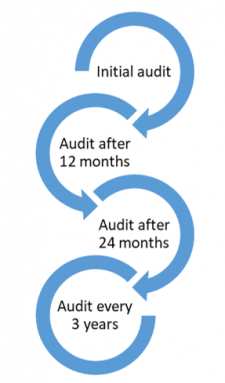
AI certification audit cycle
After obtaining your certification, you enter in a cycle of annual audits:
For any request with LNE Digital certification, artificial intelligence, contact us by clicking on "Obtain a quote".
Certifier notre solution Infracare nous a permis de rassurer nos clients potentiels et de leur démontrer notre niveau d’expertise...

En plus d’être une étape essentielle de notre préparation à l’AI Act, notre méthode projet certifiée nous permet de créer des solutions IA dignes de confiance.

Les bénéfices de cette certification sont multiples et nous ont tous procuré des avantages compétitifs